
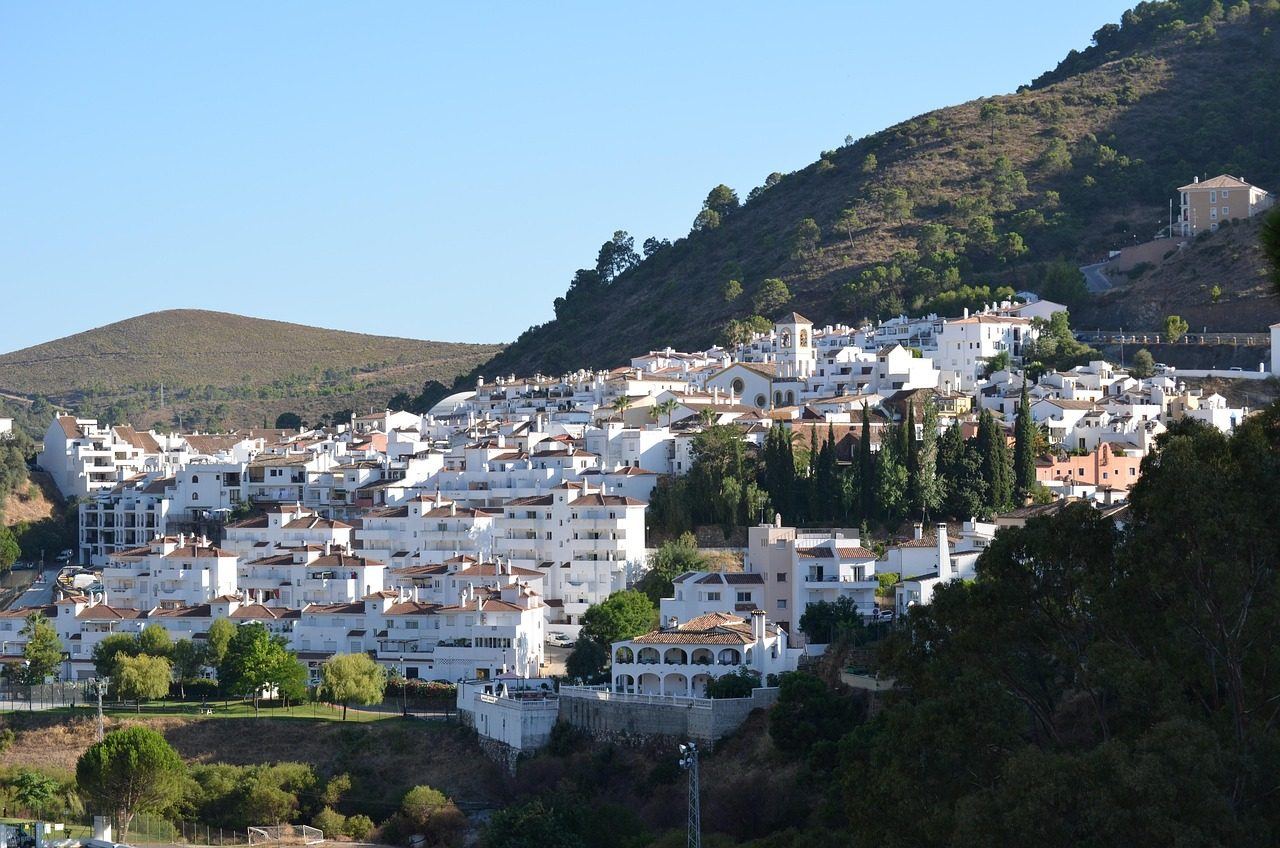
Most owners we onboard in Coín price their weekends the way they would price a coastal apartment: a small Friday-to-Sunday uplift, perhaps ten or fifteen per cent above a Tuesday night, and the same shape applied month after month. That logic does not work here. Coín is not a beach town with a flat tourist baseline, and the rhythm of its short-let calendar is not driven by sunshine. It is driven, more than any other single factor, by Sunday morning — by a market that fills the casco histórico from dawn and pulls visitors out of the coast, the valley, and the inland villages in a way that no other inland Málaga town can match.
If you own a short-let in Coín and you treat Sunday as a tail-end night, you are leaving real money on the table. The booking patterns we see across our managed inventory tell a consistent story: Friday-to-Sunday weekends in Coín are anchored by the market, not by the weather, and the pricing should reflect that.
What the Sunday market actually is
The Coín Sunday market — the mercadillo held weekly in and around the streets near the recinto ferial — is genuinely one of the largest in Andalucía. We say that with care, because superlatives on the Costa del Sol are usually marketing. In this case the size is real. Hundreds of stalls, produce from across the Guadalhorce valley, textiles, leather, household goods, plants from the local viveros, and a food and bar scene that spills into the surrounding cafés through the late morning. It runs through the morning and tails into early afternoon, with the busiest window between roughly nine and one.
The catchment is what owners often underestimate. It is not just locals doing a weekly shop. The market draws day visitors from Alhaurín el Grande and Alhaurín de la Torre, from Cártama, from Mijas Pueblo and Mijas Costa, from Fuengirola and Benalmádena, and on a good Sunday from as far as Marbella and the city of Málaga. The drive from the coast is under forty minutes for most of the western Costa del Sol. For the inland Guadalhorce villages it is fifteen minutes or less. That single morning is, for many of those visitors, the reason they came inland at all.
For short-let owners, this matters because it changes who is renting your property on a Saturday night and why. The guest is not in Coín because Coín is on a coastal itinerary. They are in Coín because they want to be in Coín on Sunday morning, in walking distance of the stalls, with a coffee on a terrace by Plaza Alameda before the crowds thicken.
Why the casco histórico is the asset
Coín's short-let inventory is small. The official VUT count sits at 101 properties — a number we have referenced before and one worth repeating because it shapes everything about how this market behaves. There is no oversupply pressure. There is no race-to-the-bottom on nightly rates. What there is, instead, is a clear geographic premium for properties inside or immediately adjacent to the casco histórico, and the Sunday market is the single biggest reason that premium exists.
The casco runs roughly between Iglesia de San Juan and Iglesia de Santa María, with Plaza Alameda functioning as the social hinge of the town. A guest staying in a townhouse or restored village house within that triangle can be at the market in five minutes on foot. They can park their hire car on Saturday afternoon and not touch it again until Sunday evening. They can walk to dinner on Saturday night, walk to breakfast on Sunday before the stalls open, and walk home with whatever they bought. That experience — and it is an experience, not a transaction — is what they are paying for, whether or not they articulate it on the listing form.
Properties further out — the hillside villas, the rural fincas off the road toward Monda or the road toward Alhaurín — rent on a different logic. They cater to longer stays, to families wanting a pool and silence, to snowbird winters. They benefit from Sunday market traffic too, but the relationship is looser. A guest in a finca will drive in for the market, park where they can, do their morning, and drive out. They are not paying a premium for proximity. The casco properties are, and the pricing should follow.
How the weekend actually shapes up
The booking shape we see for well-positioned Coín casco properties is not the smooth Friday-Saturday-Sunday curve you see in Fuengirola or Torremolinos. It is closer to a two-night anchor: Friday and Saturday, with the Saturday night driven explicitly by Sunday morning intentions, and a Sunday checkout that runs late — often eleven or twelve rather than the standard ten — because guests want to walk the market before they leave.
Three-night Friday-to-Monday stays are common in shoulder season, particularly October to early December and February to May, when day-trip weather is reliable but coastal beach demand is not at peak. Spanish guests from Málaga and Sevilla city drive in for a long weekend, anchored by Saturday dinner in the casco, Sunday market, and a Monday morning before driving home. The market is not the only reason they come, but it is the reason they stay through Sunday night rather than checking out on Saturday.
What this means for pricing is straightforward, even if too few owners act on it. Saturday night, for a casco property, should be priced meaningfully above Friday — not by ten or fifteen per cent but often by twenty-five to thirty-five depending on season. Sunday itself, treated as a checkout day for the Friday-Sunday booking, should not be discounted into oblivion when it appears as a standalone night, because there is a small but real market for Sunday-night arrivals from guests doing a Monday-Tuesday hike around the Sierra de las Nieves or extending into a longer inland trip.
We get into the underlying mechanics of this on the pricing and income side of the site, and the broader weekend-shape logic is something we apply across our services generally, but the Coín specifics are unusual enough to deserve their own treatment.
The agritourism layer the platforms miss
There is a second guest profile that the booking platforms tend to bundle into generic categories but which behaves quite differently. Call it the agritourism weekend — a slow-tourism segment, often Spanish couples in their thirties and forties, sometimes Northern European retirees living elsewhere on the coast, who are explicitly looking for the Guadalhorce experience rather than a beach weekend.
For these guests the Sunday market is not a side attraction. It is the centrepiece. They will plan a weekend around it: arrival on Friday afternoon, Saturday spent walking around Coín and perhaps driving to one of the neighbouring pueblos blancos, Saturday evening eating in the casco, Sunday morning at the market with cash for olive oil, citrus, cheese, and whatever ceramics catch their eye, and a long lunch before checking out. The whole shape of their booking is built backwards from Sunday morning.
This profile pays well, books direct more often than the platform average, and rebooks. We have managed properties in the casco where the same Madrid couple has returned four or five times in eighteen months, each time anchored to a Sunday they want to be at the market. They do not want a coastal apartment with a pool view. They want a townhouse with a roof terrace, original tiles, a working kitchen, and the church bells in earshot. If your property matches that brief, the Sunday market is your single most important marketing asset, and you should be writing the listing copy as if you knew that.
Pricing the rest of the week against Sunday
If Saturday is the anchor, what should the rest of the week look like? This is where the inland short-let logic diverges sharply from the coast.
Tuesday and Wednesday nights in Coín do not rent at coastal rates. They rent, when they rent at all, to long-stay segments — snowbirds in winter, mid-stay relocating families, the occasional rural-finca guest extending into a midweek. Pricing a Tuesday night on a casco property at the same level as a coastal one-bed is a fast way to lose the booking entirely and have it block your Friday and Saturday by sitting empty. The realistic shape is a midweek that runs thirty to forty per cent below Saturday, a Friday around fifteen to twenty per cent below Saturday, and a Sunday-as-standalone that sits somewhere between Friday and midweek depending on the season.
Long-stay logic complicates this further. A four-week February booking from a Belgian retiree wanting winter sun without the coastal crowds will, on the right property, out-earn four standalone weekends — and it will absorb the Sunday market weekends inside its block. That is not a bad outcome, but it is one to plan deliberately rather than fall into. Many of our Coín owners explicitly hold Saturday nights open for short-let in shoulder season and offer long-stay only in deep winter and high summer, when the weekend short-let demand thins out. The DAFO and licensing complications around rural fincas — which we have written about elsewhere in detail — sit alongside this, but for casco properties the licence path is cleaner and the VUT licence work is usually the simpler part of the operational setup.
Operational notes most owners overlook
A few practical points that follow from all of this, and which we apply across the properties we manage from our office in Arroyo de la Miel.
Saturday check-ins in Coín should be earlier than the regional default. Three in the afternoon is fine for Fuengirola. In Coín, where the guest's primary plan is dinner in the casco followed by Sunday morning at the market, an earlier check-in window — two, or even one with a small surcharge — pays for itself in review quality and repeat bookings. Guests notice when the property is configured around what they actually came to do.
Sunday checkouts should be late. The market does not really thin until after one. A standard ten o'clock checkout forces guests to leave before they have done the thing they booked for. Eleven, twelve, even one with a half-day surcharge for a particular property profile — this is what the casco short-let actually needs.
Welcome packs should reference the market specifically and accurately. Not a generic "local market on Sundays" line, but the actual streets, the actual hours, the recommendation to arrive before ten if they want produce and after eleven if they prefer the social atmosphere, and a note on where to park if they have a hire car. Owners managing remotely from northern Europe consistently get this wrong, because they have never walked the market themselves on a Sunday morning. Local management closes that gap.
Photography should include at least one image that places the property in the casco — a street shot, the walk to Plaza Alameda, the roof terrace with the bell tower visible. The platforms reward listings that signal location specifically. A casco property photographed as if it could be anywhere underprices itself by twenty per cent before the first booking comes in.
What this means if you are buying
For owners considering a purchase in Coín for short-let purposes — and we have walked a steady stream of these in 2025 and into 2026 — the Sunday market should be part of the location calculus, not an afterthought. A village house ten minutes' walk from Plaza Alameda will rent on a different curve than one three minutes away, and the gap is real money over a calendar year. The 101 VUT count means there is no flood of competition, but it also means data is thinner and pricing comparables are harder to read from the outside. Our estimator gives a directional sense of what a specific address can produce, and from there the conversation about whether a property is worth the asking price becomes a great deal more grounded.
The broader pattern is this. Coín is not a coastal market with inland prices. It is its own market, with its own rhythms, and the Sunday market is the single clearest expression of that. Owners who price and operate against the local calendar earn meaningfully more than owners who apply a coastal template. The gap is not subtle.
If you own a property in Coín — or are considering one — and you would like to talk through how the weekend pricing shape would apply to your specific address, get in touch with our office. We work the Guadalhorce inland properties from the same team that runs our coastal inventory, and the Sunday-morning logic is something we build into the calendar from the first onboarding conversation.